

Primary Healthcare Strengthening leadership and governance for resilient health systems.
Primary healthcare is the foundation of effective, equitable, and resilient health systems. Yet around the world, leadership and governance gaps continue to limit progress.
01
What Global Institutions are Emphasizing
Global health institutions increasingly recognize that stronger health outcomes depend not only on clinical services but also on leadership capacity, governance effectiveness, management effectiveness, accountability, and community engagement.
“UNICEF will aim to build district and health facility management teams’ capacity for evidence-based planning, implementation and frequent monitoring.”
— UNICEF, Strategy for Health 2016–2030, p. 15. Read the report →
02
The Emerging Consensus
The World Bank argues that countries must rethink how primary healthcare is designed, financed, delivered, and governed in the post-COVID world. 4.5 billion people lack access to essential health services, and 60–80% of health needs can be met through primary healthcare. Primary healthcare is critical to achieving Universal Health Coverage and the health-related Sustainable Development Goals (SDGs).
“The time is right for reimagining PHC—not to redefine it abstractly but to clarify practical steps countries can take to make PHC fit-for-purpose in the 21st century, starting now.”
— World Bank, 2022, Walking the Talk: Reimagining Primary Health Care After COVID-19, Chapter 1, p. 13. Read the report →
03
Monitoring Leadership & Performance
WHO and UNICEF emphasize the importance of measuring health systems through a primary healthcare lens, capturing not only service delivery but also governance, equity, responsiveness, and community trust.
“Monitoring, evaluation and review of health progress and performance are essential to ensure that priority actions and decisions are implemented as planned against agreed objectives and targets.”
— WHO & UNICEF, Primary Health Care Measurement Framework, p. 4. Read the report →
04
The Implementation Challenge
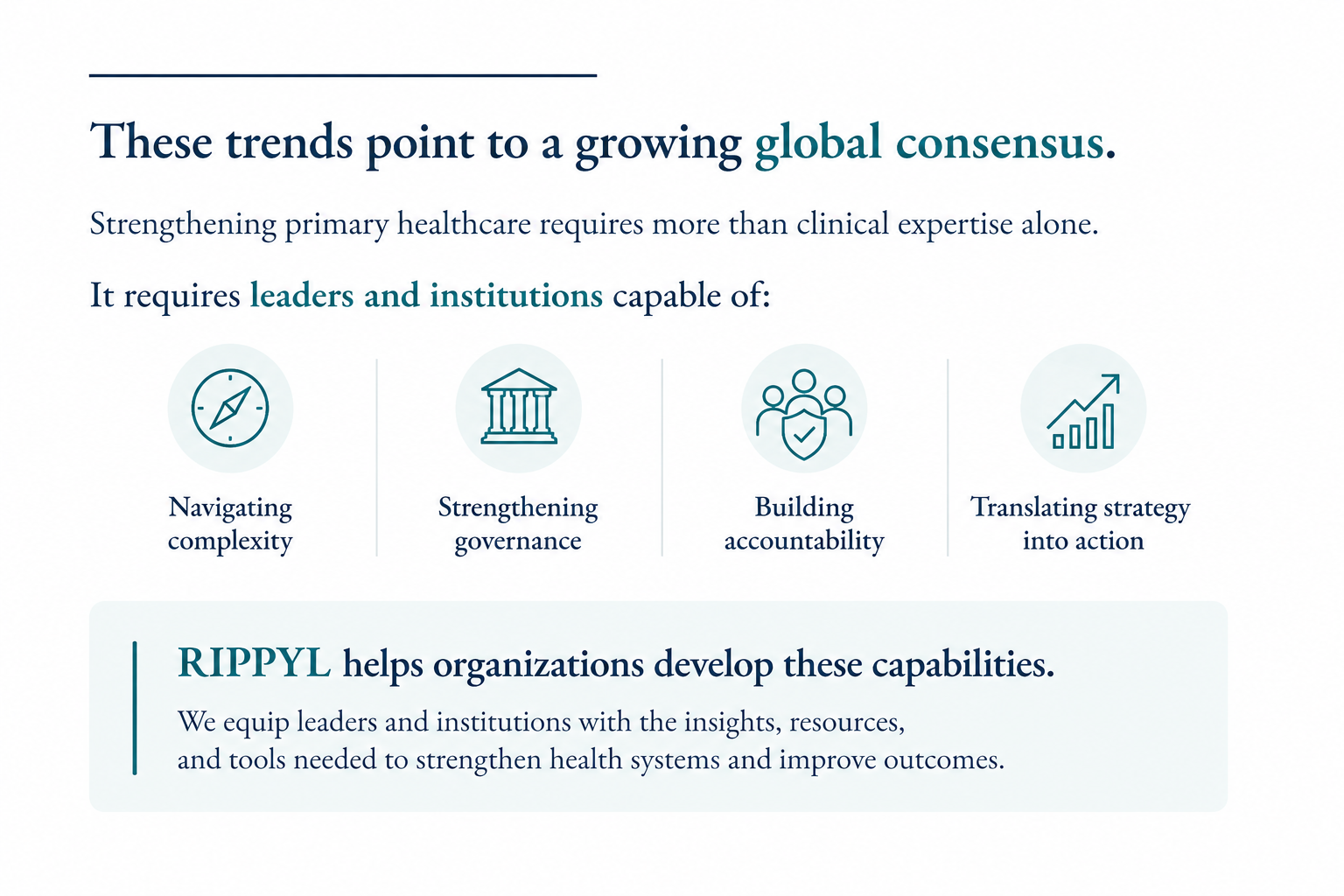
What institutions know vs. what institutions can execute.
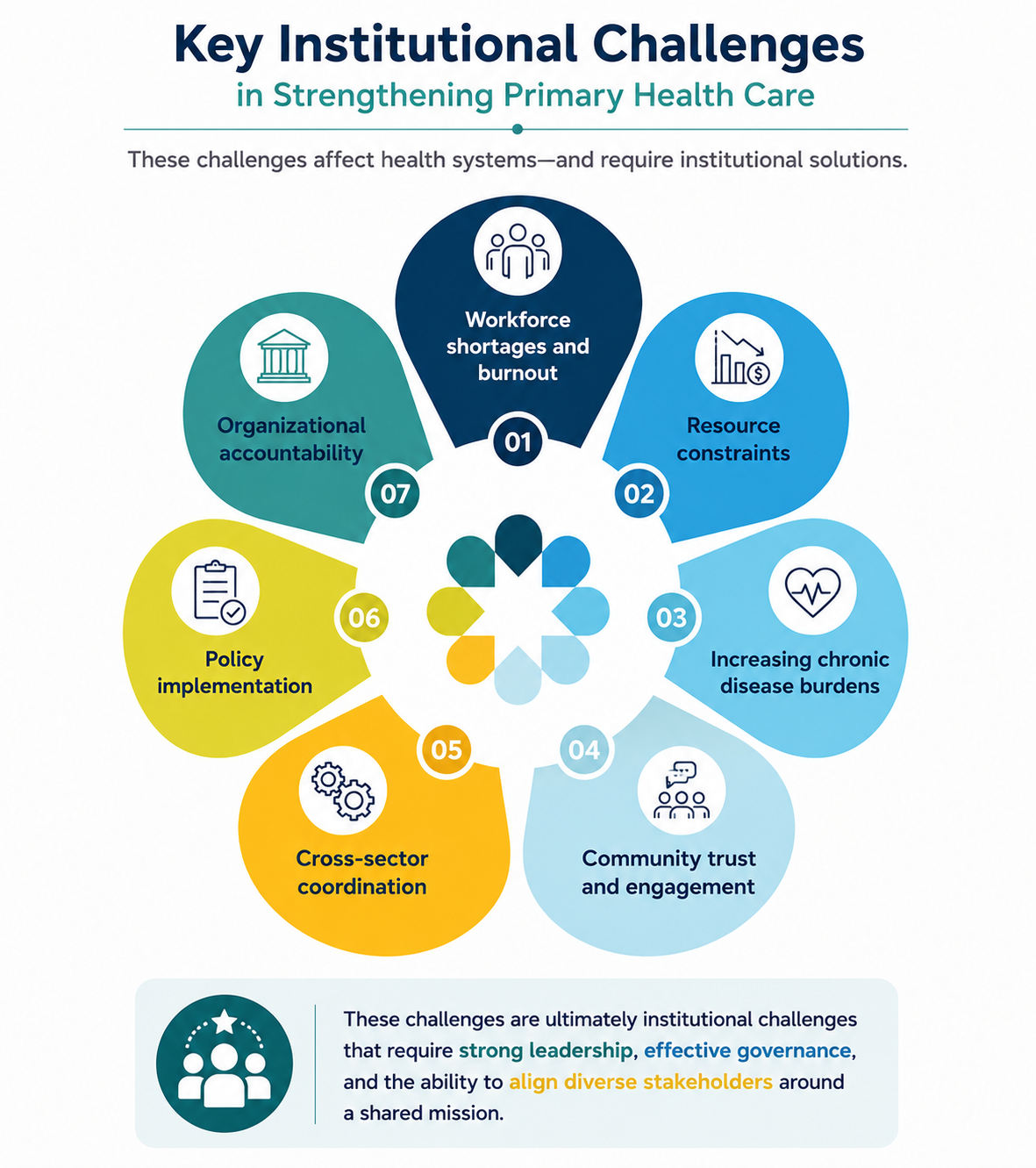
Global institutions have identified what is needed to strengthen primary healthcare. The challenge now is implementation. Policies, frameworks, and priorities only create impact when institutions possess the governance structures, accountability mechanisms, management systems, and organizational capacity necessary to execute them consistently over time.
05
The Leadership Challenge
Strong primary healthcare systems ultimately depend on leadership. Leaders must navigate uncertainty, align diverse stakeholders, build trust, manage competing priorities, and create the conditions for sustainable change. The quality of leadership often determines whether ambitious reforms succeed, stall, or fail.
06
An Institutional Intelligence Perspective
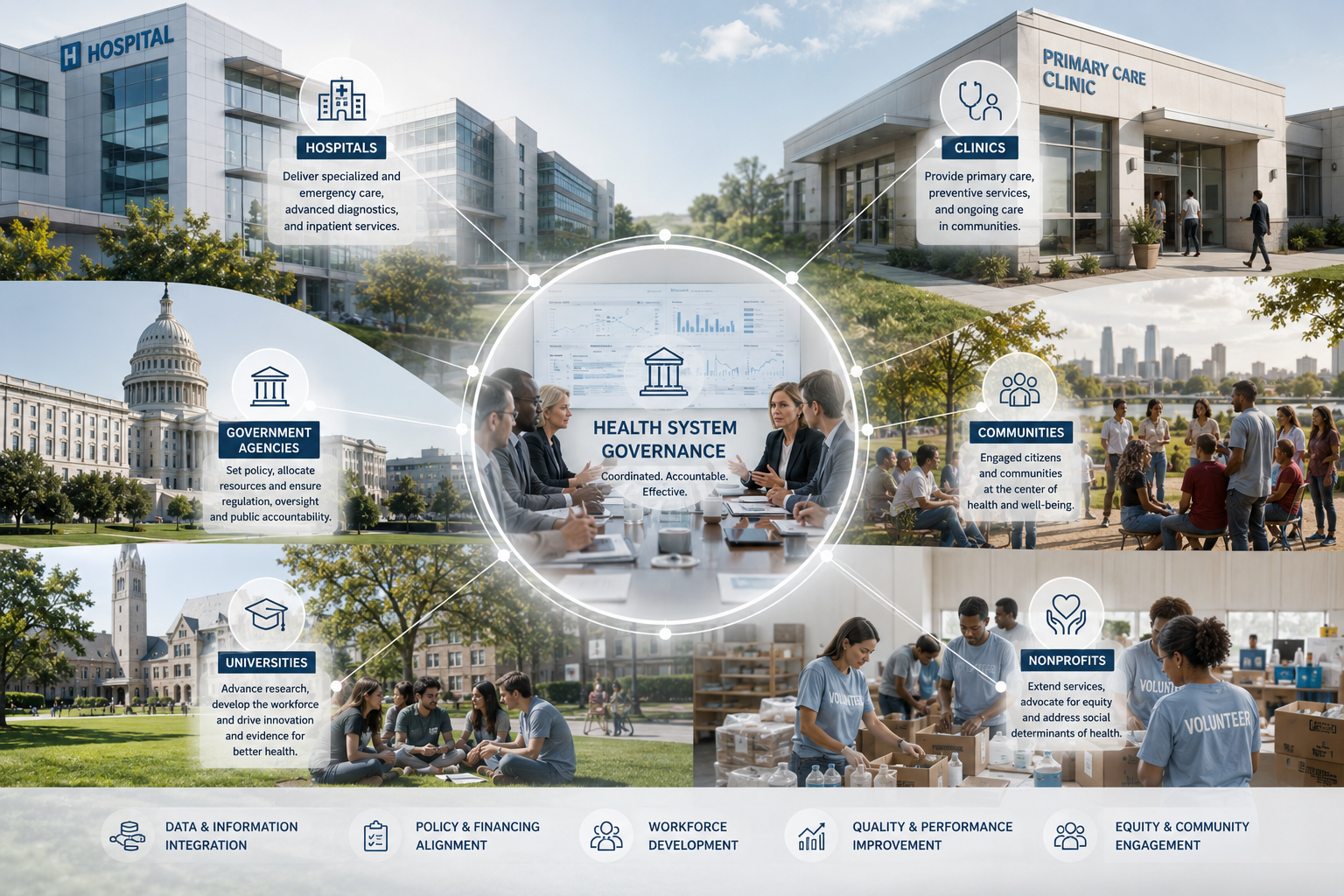
At RIPPYL, we approach primary healthcare through the lens of institutional intelligence. Success depends not only on clinical expertise but on understanding the leadership dynamics, governance conditions, organizational capabilities, and emerging risks that shape institutional performance. By making these factors visible, leaders gain access to forms of institutional knowledge that would otherwise remain hidden.
07
RIPPYL: Equipping Leaders and Institutions for Transformation
RIPPYL Intelligence transforms organizational information into actionable institutional intelligence. By revealing leadership strengths, governance vulnerabilities, emerging risks, and emerging opportunities, leaders gain the clarity needed to make more informed decisions.
Through structured inquiry, advanced analytics, and expert interpretation, leaders gain access to actionable intelligence that supports stronger governance, more informed decision-making, and sustained institutional effectiveness.
The result is greater clarity, stronger institutions, and improved capacity to achieve meaningful and lasting impact.